
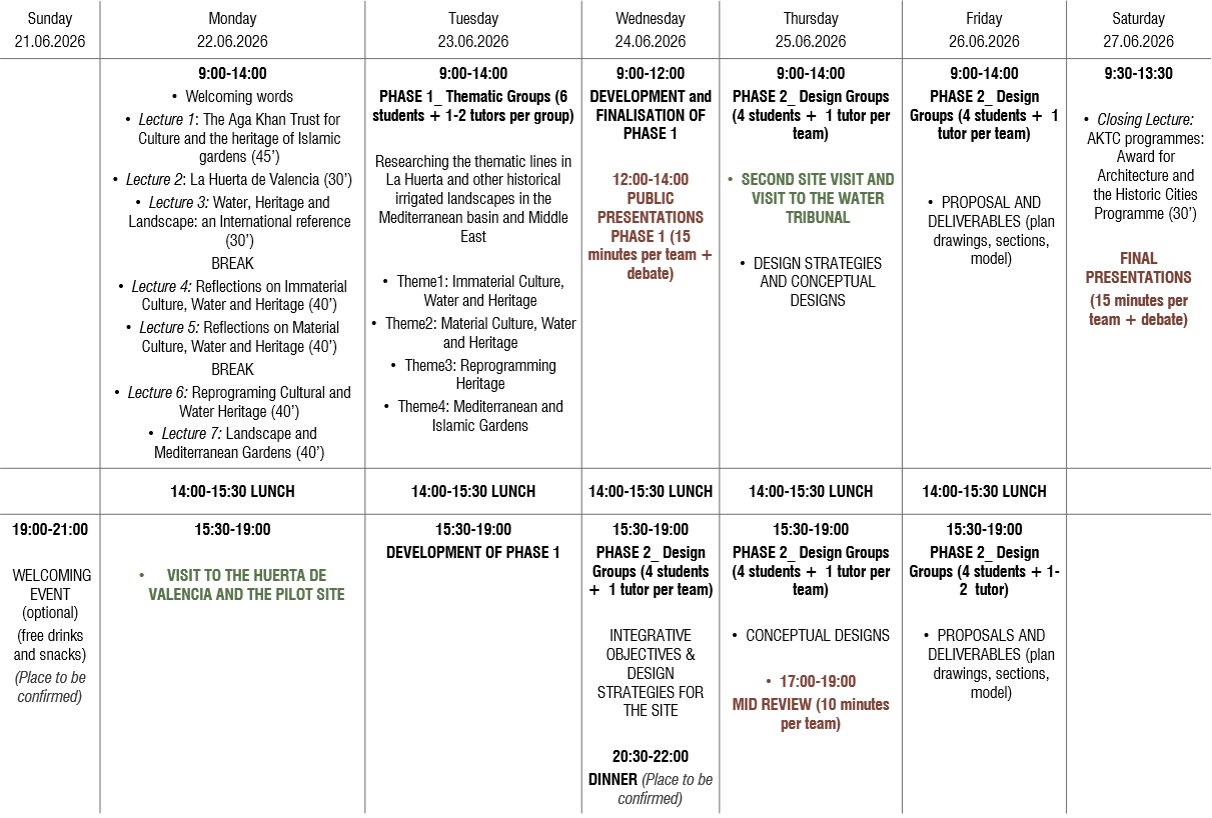
DATES: 21-27 June 2026 (Weekdays: 9:00-14:00 and 15:00-19:00, Saturday: 9:00-14:00).
PLACE: School of Architecture of Valencia (Technical University of Valencia)
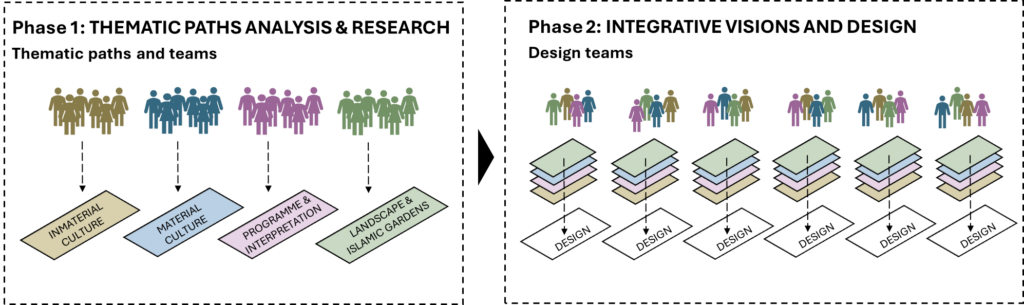
PHASE1: THEMATIC PATHS ANALYSIS AND RESEARCH (in Thematic teams)
- Thematic Team 1: Immaterial Culture
- Thematic Team 2: Material Culture
- Thematic Team 3: Programme and Interpretation
- Thematic Team 4: Landscape & Islamic Gardens
- Day 1 (Monday, 22.06.2026) Introductory Lectures and Visit to the Huerta and the Site
- Day 2 (Tuesday, 23.06.2026) Research and Analysis of the Huerta and the Pilot Site
- Activation and development of works
- Day 3 (Wednesday, 24.06.2026) Research and Analysis of the Huerta and the Pilot Site
- Finalisation and presentation of results
PHASE2: INTEGRATIVE VISIONS AND DESIGN (in Design teams with members from each Thematic team)
- Day 4 (Thursday, 25.06.2026): Conceptual Design for the complex of outdoor spaces and for the main garden + Visit to the Water Court
- Day 5 (Friday, 26.06.2026): Preliminary proposals + Intermediate review
- Day 6 (Saturday, 27.06.2026): Final presentations and reflections +
PROGRAMME:
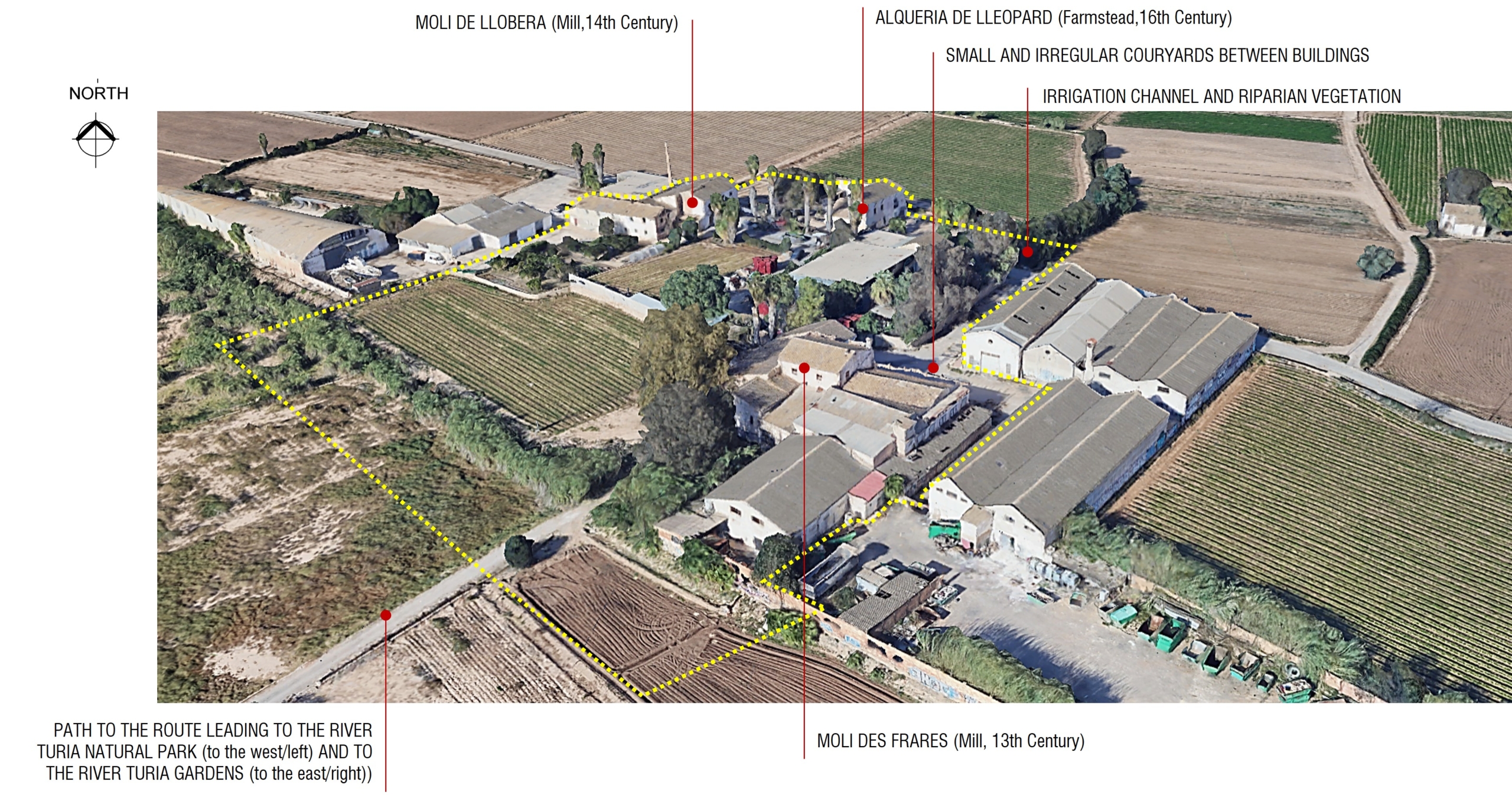
PILOT AREA
The Huerta de Valencia is a cultural landscape located in the alluvial plain formed by the Turia river and intimately linked to the city of Valencia and other towns located in the Metropolitan Area of Valencia. Its foundations were established during the Roman period, but it was in the Middle Ages – with the presence of Muslim civilisation in Iberia- that the Tribunal de las Aguas was established to manage the use of the water and distribute it between farmers. The Christian reconquest established a feudal system that restructured the Huerta. During this period, the irrigation systems were expanded, and the political and social structure of the area was modified. The landscape originated with feudalism lasted until the nineteenth century. The arrival of the twentieth century significantly altered the physiognomy of the Huerta, which witnessed the expansion of urban areas and the increase in transport infrastructures with the subsequent fragmentation of the agricultural space and the loss of environmental and cultural heritage. Following the preliminary drafting of a Protection Plan in the year 2010 and the approval of the final Act and Plan in the year 2018, the cultural landscape of la Huerta de Valencia is now protected to guarantees its continuity for future generations.
For the development of the course, an especially relevant site has been chosen in the Huerta of Valencia (Moli des Frares (13th Century) and Azud de Rovella (10th -11th Century A.D.)). This site concentrates some of the oldest and most valuable pieces of traditional architecture and some of the most representative samples of water infrastructure. In addition, the site is strategically located close to one of the most popular and used routes in the Huerta, what increases its potential to accommodate a renovated and diversified programme combining public and private ventures. Moreover, by being in one of the best-preserved areas of the Huerta, the site could also be perceived as an ideal hub for landscape education and cultural interpretation.